ESP32 Development Board | High-performance for Quadruped Robots
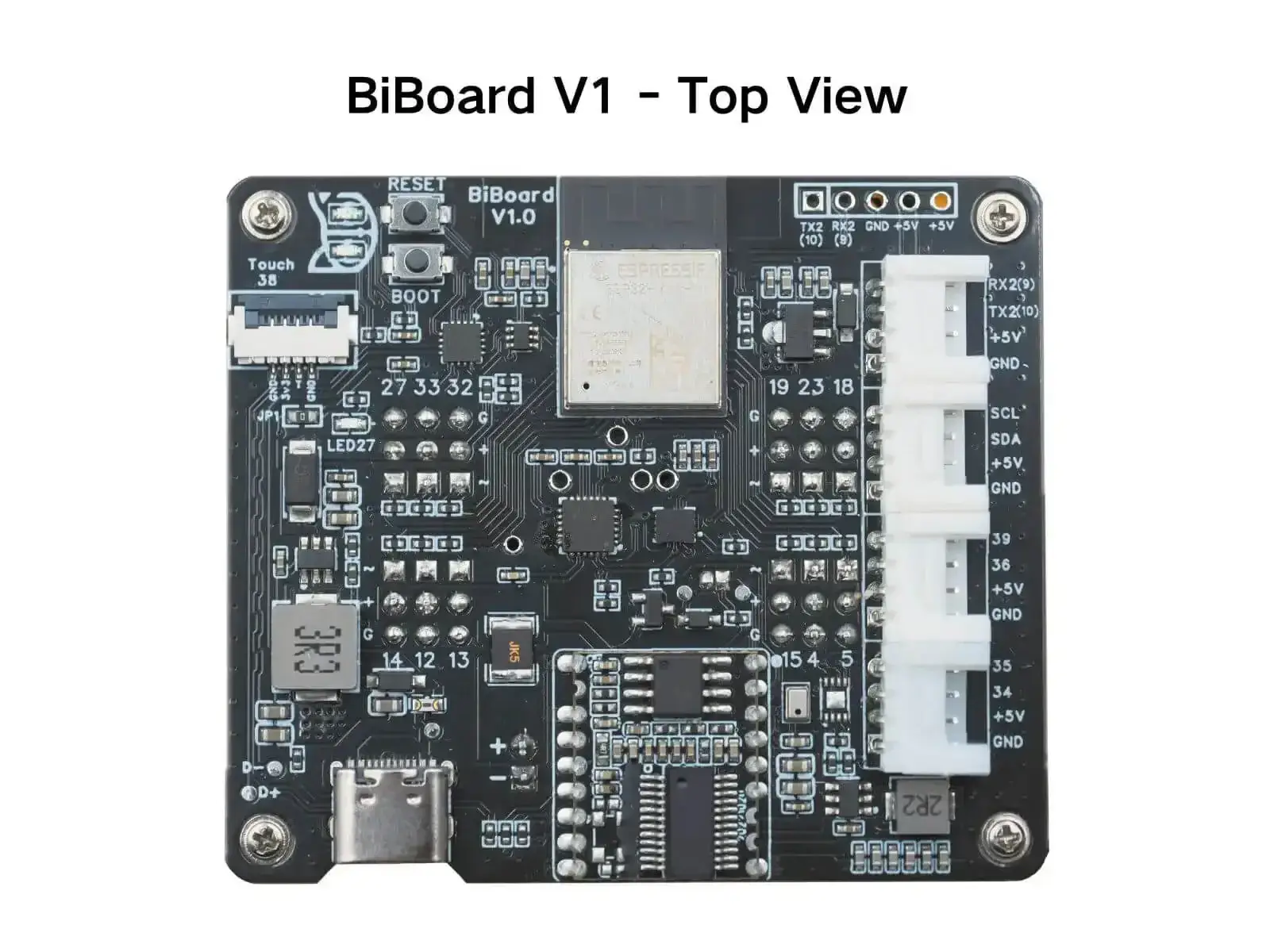
BiBoard is an ESP32-based robot microcontroller board developed by Petoi. With a high-performance processor, larger memory and storage, and wireless connections, it is mainly designed for developers and engineers working on multi-degree-of-freedom (Multi-joint) robots with up to 12 servos. An audio function is also included.
Features
- Drive 12 PWM servos
- An IMU (Inertial Measurement Unit) is used for detecting body status (orientation and acceleration) to balance
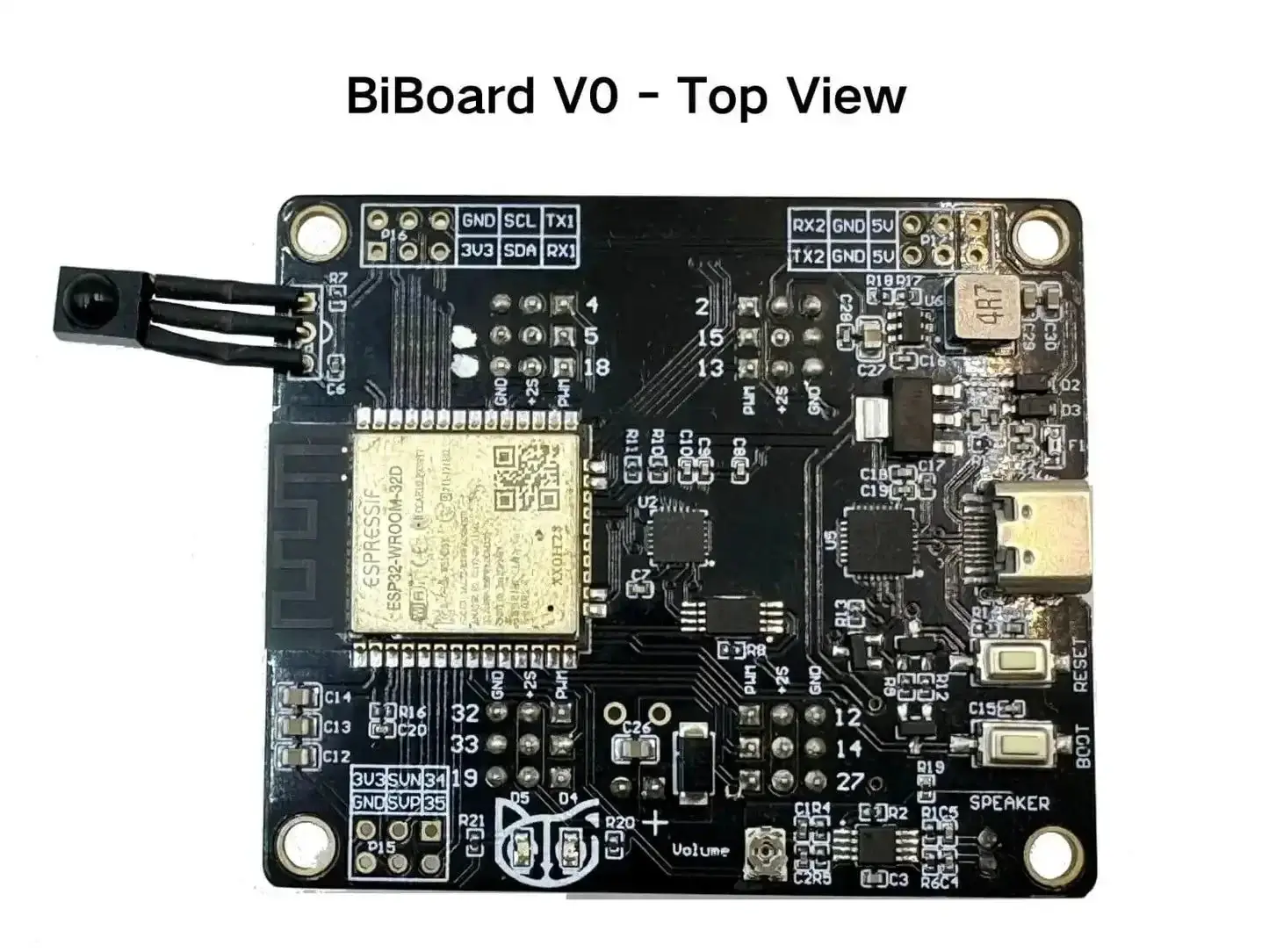
- Infrared remote controller (only on the V0 board)
- 4 Grove sockets for external modules.
- USB Type-C port for uploading firmware and serial communication.
- 64Kbit I2C EEPROM (optional on the V1 board)
- DAC and audio application.
-
- Built-in connectivity support
- Serial
- Bluetooth
- WiFi
- Compatible with Petoi open source quadruped robotics kits, such as robot dog Bittle X and robot cat Nybble Q
- Raspberry Pi support
- The V1 board provides a 5-pin socket for mounting Raspberry Pi directly.
- For the V0 board, you must use wires or adapters to mount the Raspberry Pi on the BiBoard. The Pi allows robotics kits such as Bittle to analyze more complex sensory data, connect to the Internet, and make decisions by itself.
The source code is open-source on GitHub and has a detailed user manual.
Example application
- Petoi's bionic robot dog Bittle fully utilized BiBoard to coordinate 8 degree-of-freedom(DOF) sophisticated motions.
- Bittle walks over an 8.5cm(3.35 inch) gap. More details from the tutorial.
Specifications
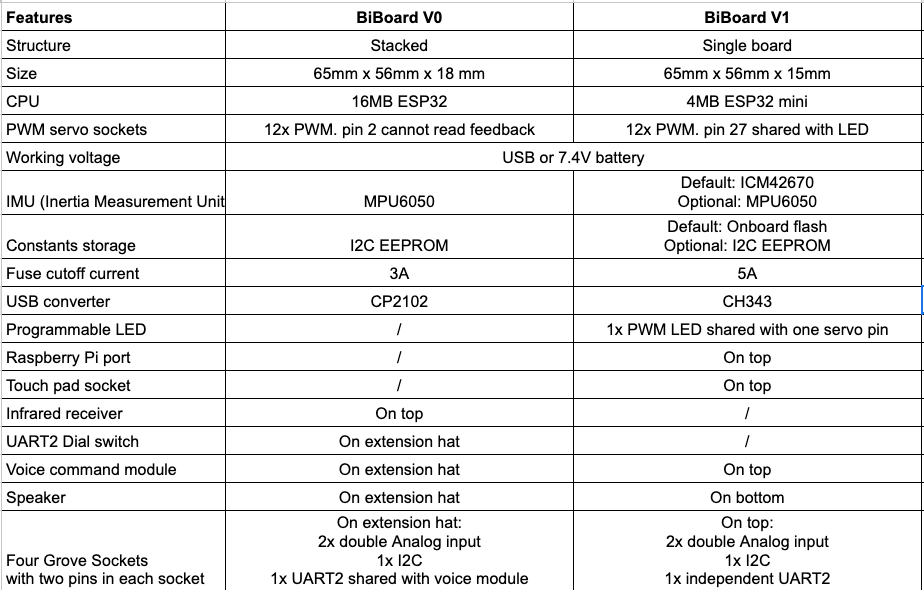
| Features | BiBoard V0 | BiBoard V1 |
| Structure | Stacked | Single board |
| Size | 65mm x 56mm x 18 mm | 65mm x 56mm x 15mm |
| CPU | 16MB ESP32 | 4MB ESP32 mini |
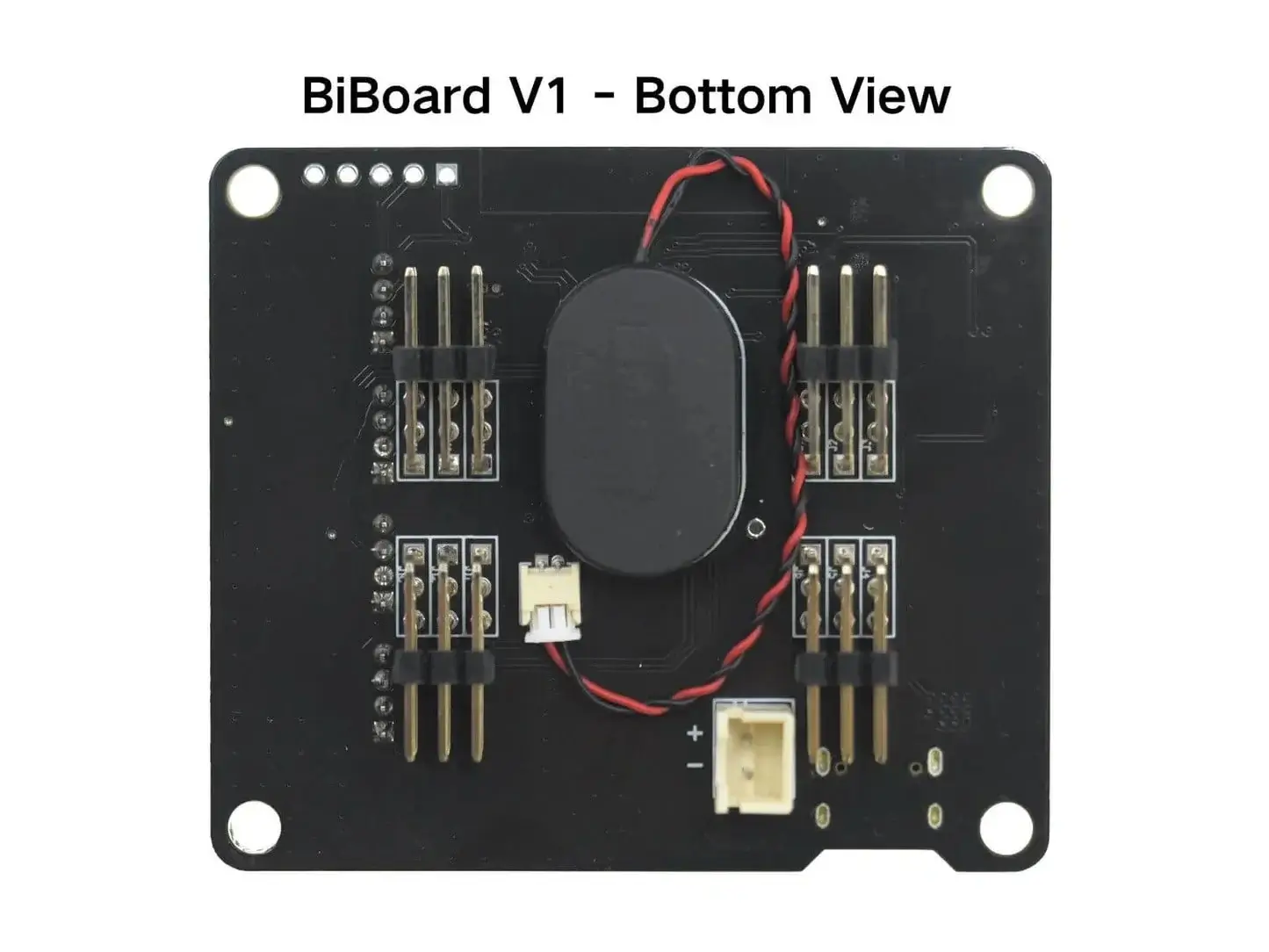
| PWM servo sockets | 12x PWM. Pin 2 cannot read feedback | 12x PWM. pin 27 shared with LED |
| Working voltage | USB or 7.4V battery | |
| IMU (Inertia Measurement Unit) | MPU6050 | Default: ICM42670 Optional: MPU6050 |
| Constants storage | I2C EEPROM | Default: Onboard flash Optional: I2C EEPROM |
| Fuse cutoff current | 3A | 5A |
| USB converter | CP2102 | CH343 |
| Programmable LED | / | 1x PWM LED shared with one servo pin |
| Raspberry Pi port |
It has the pinouts, but doesn't have a dedicated socket for the Pi. Not recommended for Raspberry Pi. |
It has a 5-pin socket to attach the Pi. It can power the Pi and communicate with it via the serial port. Support Raspberry Pi 3 A+, 3B, 4, 5. |
| Touch pad socket | / | On top |
| Infrared receiver | On top | / |
| UART2 Dial switch | On an extension hat | / |
| Voice command module | On an extension hat | On top |
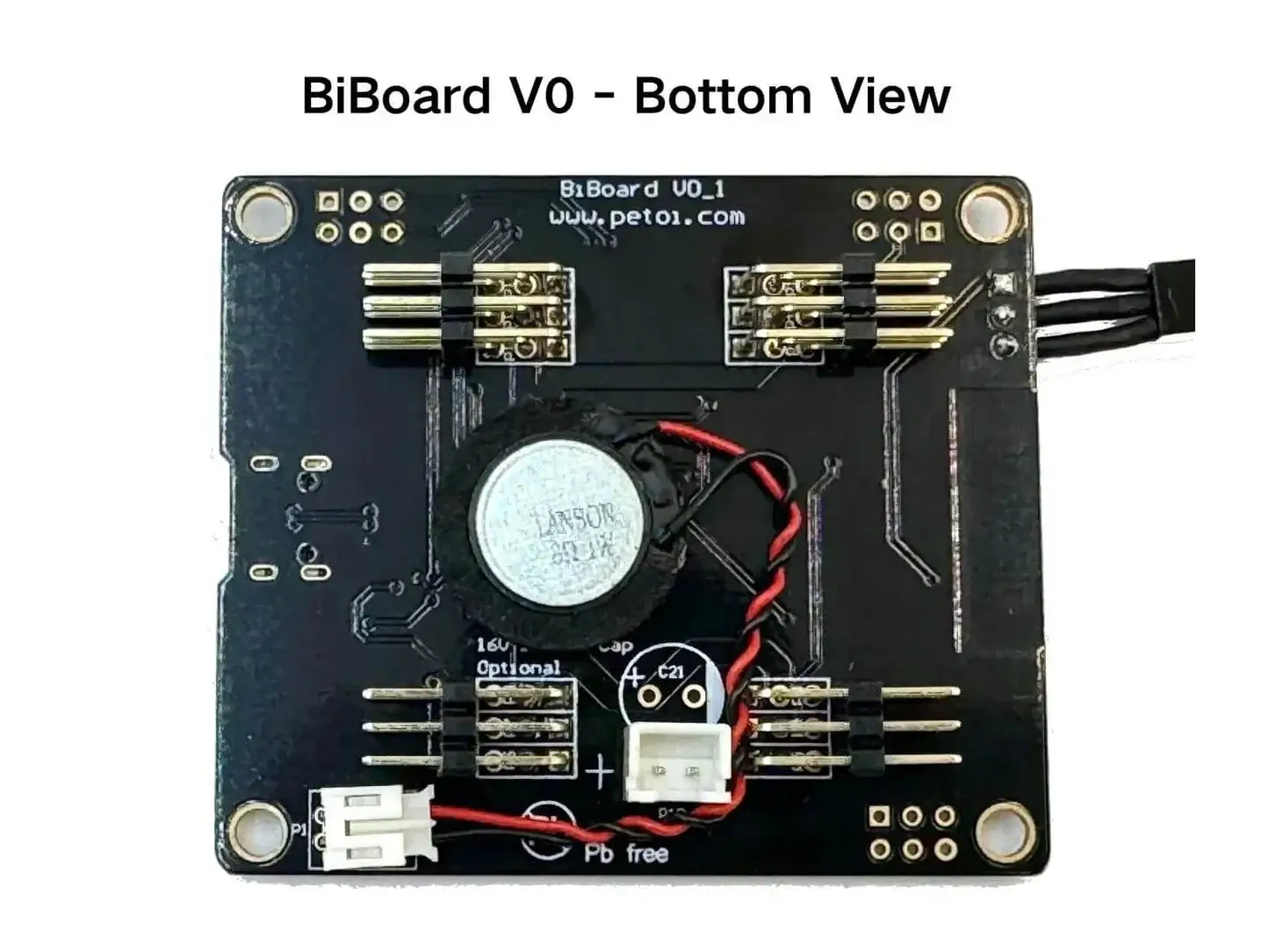
| Speaker | On the extension hat | On bottom |
| Four Grove Sockets with two pins in each socket |
On extension hat: 2x double Analog input 1x I2C 1x UART2 shared with voice module |
On top: 2x double Analog input 1x I2C 1x independent UART2 |
BiBoard V1 has the voice command module built into the board
Please see the documentation for more details.
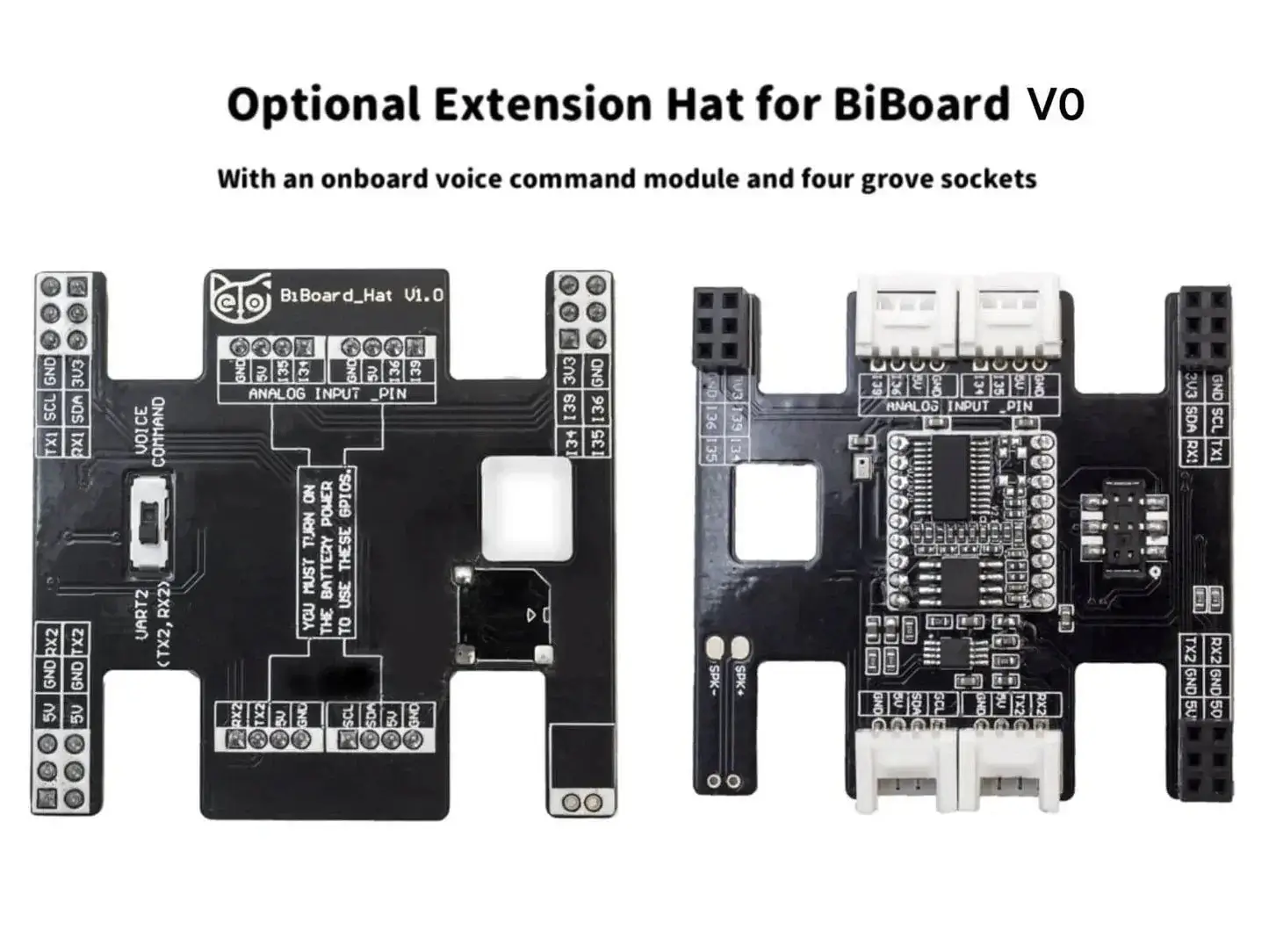
BiBoard V0 with extension hat and voice command module
See the documentation for more details.
Discount for existing customers upgrading
If you are an existing customer with older generations of Bittle, Nybble running on NyBoard or BiBoard V0, and want to upgrade to use BiBoard V1, please contact us for a special upgrade discount.
More Images
ESP32 Development Board | High-performance for Quadruped Robots
BiBoard is an ESP32-based robot microcontroller board developed by Petoi. With a high-performance processor, larger memory and storage, and wireless connections, it is mainly designed for developers and engineers working on multi-degree-of-freedom (Multi-joint) robots with up to 12 servos. An audio function is also included.
Features
- Drive 12 PWM servos
- An IMU (Inertial Measurement Unit) is used for detecting body status (orientation and acceleration) to balance
- Infrared remote controller (only on the V0 board)
- 4 Grove sockets for external modules.
- USB Type-C port for uploading firmware and serial communication.
- 64Kbit I2C EEPROM (optional on the V1 board)
- DAC and audio application.
-
- Built-in connectivity support
- Serial
- Bluetooth
- WiFi
- Compatible with Petoi open source quadruped robotics kits, such as robot dog Bittle X and robot cat Nybble Q
- Raspberry Pi support
- The V1 board provides a 5-pin socket for mounting Raspberry Pi directly.
- For the V0 board, you must use wires or adapters to mount the Raspberry Pi on the BiBoard. The Pi allows robotics kits such as Bittle to analyze more complex sensory data, connect to the Internet, and make decisions by itself.
The source code is open-source on GitHub and has a detailed user manual.
Example application
- Petoi's bionic robot dog Bittle fully utilized BiBoard to coordinate 8 degree-of-freedom(DOF) sophisticated motions.
- Bittle walks over an 8.5cm(3.35 inch) gap. More details from the tutorial.
Specifications
| Features | BiBoard V0 | BiBoard V1 |
| Structure | Stacked | Single board |
| Size | 65mm x 56mm x 18 mm | 65mm x 56mm x 15mm |
| CPU | 16MB ESP32 | 4MB ESP32 mini |
| PWM servo sockets | 12x PWM. Pin 2 cannot read feedback | 12x PWM. pin 27 shared with LED |
| Working voltage | USB or 7.4V battery | |
| IMU (Inertia Measurement Unit) | MPU6050 | Default: ICM42670 Optional: MPU6050 |
| Constants storage | I2C EEPROM | Default: Onboard flash Optional: I2C EEPROM |
| Fuse cutoff current | 3A | 5A |
| USB converter | CP2102 | CH343 |
| Programmable LED | / | 1x PWM LED shared with one servo pin |
| Raspberry Pi port |
It has the pinouts, but doesn't have a dedicated socket for the Pi. Not recommended for Raspberry Pi. |
It has a 5-pin socket to attach the Pi. It can power the Pi and communicate with it via the serial port. Support Raspberry Pi 3 A+, 3B, 4, 5. |
| Touch pad socket | / | On top |
| Infrared receiver | On top | / |
| UART2 Dial switch | On an extension hat | / |
| Voice command module | On an extension hat | On top |
| Speaker | On the extension hat | On bottom |
| Four Grove Sockets with two pins in each socket |
On extension hat: 2x double Analog input 1x I2C 1x UART2 shared with voice module |
On top: 2x double Analog input 1x I2C 1x independent UART2 |
BiBoard V1 has the voice command module built into the board
Please see the documentation for more details.
BiBoard V0 with extension hat and voice command module
See the documentation for more details.
Discount for existing customers upgrading
If you are an existing customer with older generations of Bittle, Nybble running on NyBoard or BiBoard V0, and want to upgrade to use BiBoard V1, please contact us for a special upgrade discount.
Product Information
Product Information
Shipping & Returns
Shipping & Returns
Description
BiBoard is an ESP32-based robot microcontroller board developed by Petoi. With a high-performance processor, larger memory and storage, and wireless connections, it is mainly designed for developers and engineers working on multi-degree-of-freedom (Multi-joint) robots with up to 12 servos. An audio function is also included.
Features
- Drive 12 PWM servos
- An IMU (Inertial Measurement Unit) is used for detecting body status (orientation and acceleration) to balance
- Infrared remote controller (only on the V0 board)
- 4 Grove sockets for external modules.
- USB Type-C port for uploading firmware and serial communication.
- 64Kbit I2C EEPROM (optional on the V1 board)
- DAC and audio application.
-
- Built-in connectivity support
- Serial
- Bluetooth
- WiFi
- Compatible with Petoi open source quadruped robotics kits, such as robot dog Bittle X and robot cat Nybble Q
- Raspberry Pi support
- The V1 board provides a 5-pin socket for mounting Raspberry Pi directly.
- For the V0 board, you must use wires or adapters to mount the Raspberry Pi on the BiBoard. The Pi allows robotics kits such as Bittle to analyze more complex sensory data, connect to the Internet, and make decisions by itself.
The source code is open-source on GitHub and has a detailed user manual.
Example application
- Petoi's bionic robot dog Bittle fully utilized BiBoard to coordinate 8 degree-of-freedom(DOF) sophisticated motions.
- Bittle walks over an 8.5cm(3.35 inch) gap. More details from the tutorial.
Specifications
| Features | BiBoard V0 | BiBoard V1 |
| Structure | Stacked | Single board |
| Size | 65mm x 56mm x 18 mm | 65mm x 56mm x 15mm |
| CPU | 16MB ESP32 | 4MB ESP32 mini |
| PWM servo sockets | 12x PWM. Pin 2 cannot read feedback | 12x PWM. pin 27 shared with LED |
| Working voltage | USB or 7.4V battery | |
| IMU (Inertia Measurement Unit) | MPU6050 | Default: ICM42670 Optional: MPU6050 |
| Constants storage | I2C EEPROM | Default: Onboard flash Optional: I2C EEPROM |
| Fuse cutoff current | 3A | 5A |
| USB converter | CP2102 | CH343 |
| Programmable LED | / | 1x PWM LED shared with one servo pin |
| Raspberry Pi port |
It has the pinouts, but doesn't have a dedicated socket for the Pi. Not recommended for Raspberry Pi. |
It has a 5-pin socket to attach the Pi. It can power the Pi and communicate with it via the serial port. Support Raspberry Pi 3 A+, 3B, 4, 5. |
| Touch pad socket | / | On top |
| Infrared receiver | On top | / |
| UART2 Dial switch | On an extension hat | / |
| Voice command module | On an extension hat | On top |
| Speaker | On the extension hat | On bottom |
| Four Grove Sockets with two pins in each socket |
On extension hat: 2x double Analog input 1x I2C 1x UART2 shared with voice module |
On top: 2x double Analog input 1x I2C 1x independent UART2 |
BiBoard V1 has the voice command module built into the board
Please see the documentation for more details.
BiBoard V0 with extension hat and voice command module
See the documentation for more details.
Discount for existing customers upgrading
If you are an existing customer with older generations of Bittle, Nybble running on NyBoard or BiBoard V0, and want to upgrade to use BiBoard V1, please contact us for a special upgrade discount.